
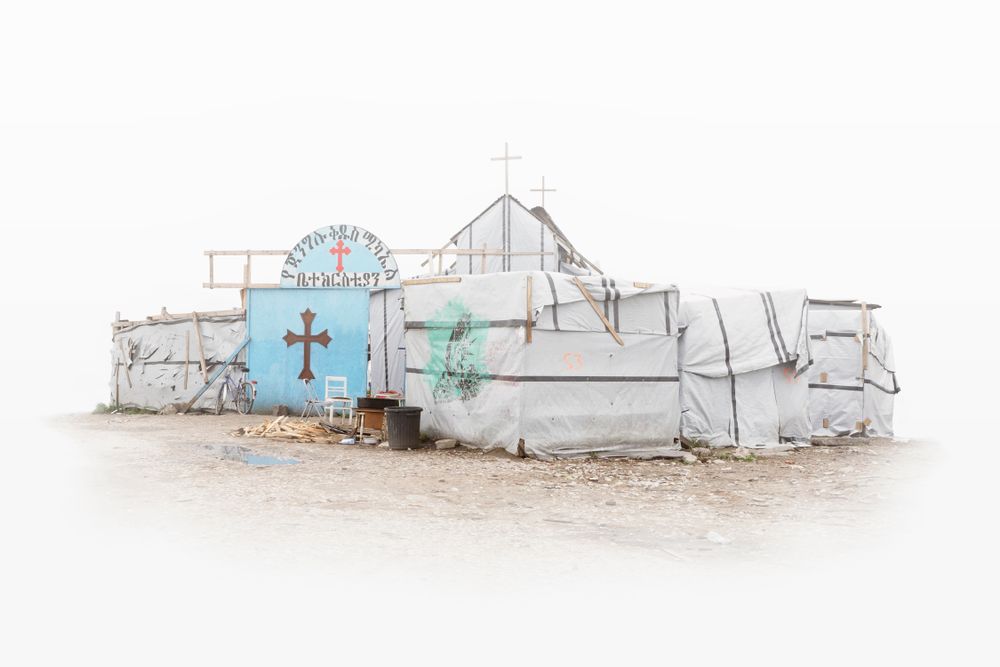

A place to live
« A place to live » is about migration, strength, and resiliency. It is about shifting the gaze, showing less to tell more. It was produced in what was known as the Calais Jungle, a place in Northern France from which asylum seekers seek to reach the UK. The series focuses on the constructions that were built by refugees living in the area as they were trying to cross the sea channel, with the help of association workers. The slum, which sheltered several thousands of people since 2014, was dismantled in October 2016 on government order. The constructions shown here are isolated from their context. They are set apart from their original environment, which has polarized French and European medias attention for many years and about which so much as been said, shown, written on, and which was finally destroyed as no better option was found. Perhaps so that it can’t be seen anymore. The buildings are standing in front of us, isolated from a noisy context. They are not anymore talking about an inextricable situation, neither are they the symbol of an international crisis, a problem we struggle to solve, a drama we don’t want to watch. They are simply standing in front of us and talk just for themselves. They are questioning us. Sometimes with violence, but also with humour. Beyond the cliches and the miserable representations which are usually associated with such places as the Calais Jungle, those constructions show us the incredible resilience of the people who built them. They tell us about lives striving for a new start, about cleverness, creativity, hope, and mutual assistance. They tell us about pain, but also about strength and optimism. As many qualities that, in another world, we might have been able to acknowledge. NB : In February 2016, the Administrative Court of Lille approved the deconstruction of the south part of the Jungle. However, the judge concluded that some of the shelters built by the migrants could be considered as « places of living », « which are necessary to the migrants and to which they are attached for cultural reasons mostly. The Judge in charge of the case considers consequently that the evacuation measure should not be applied to those places of living. ». Considering this decision, migrants and associations started writings on the shacks. Most of them were destroyed a few days later, during the demolition of the south part of the Jungle.
No categories selected
Photos (10)


