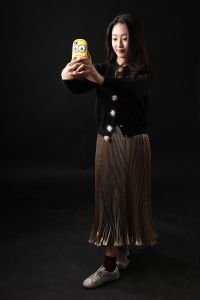

SELFIE
Human beings have been leaving their faces for a long time, such as the mummy of the pyramid, the statues of the Greek and Roman period, and the murals of the tombs. People with power and wealth made artists paint their own portraits, leaving numerous self-portraits themselves. Since Joseph Nicephore Niepce invented the photograph in 1827, many people have had their portraits taken. Since the invention of the 21st century smartphone they all have been enthusiastically playing selfie and posting it on social networking sites. Wherever you go, you can see people take selfie. Then why do people fall into selfie? Basically, Human beings have a desire to leave their faces, but the innovative technology of combining the camera and the communication that came into the palm of the hand played a major role in the enormous spread of selfie. Then what does it mean as a social and cultural phenomenon? Is it narcissus or an exploration of self-identity? In order to objectify this question, I targeted the people who take selfies. Here I find one clue. One is a photographer and one’s own object. Therefore the subject is object at the same time. In fact, contiguity is more significant than resemblance in that photos are the traces of light. Phillipe Dubois says that the index logic gives strong power to the image endlessly in his book, L’acte photographique, and that desire is always caused by contiguity rather than resemblance. If so, is selfie related to the contiguity to the object within an arm length? When we gaze at an object, the eyes produce an image that was not in the original object. Jacques Lacan expressed this as stealing his image from the things. In other words, the self-image stolen from the object provides deep narcissism to the subject, thereby creating its hallucinatory satisfaction. So, when we take a picture, it is to gaze at an object through the lens, and the eye becomes filled with our own image while we are staring at. Ego creates inevitably a psychedelic satisfaction by producing or stealing the image of itself in the place where he stares at. If the object is himself, and if it is also within the arm’s length, then the satisfaction will be sufficient to offer narcissistic Jouissance.
No categories selected
Photos (30)