
No Man's Land
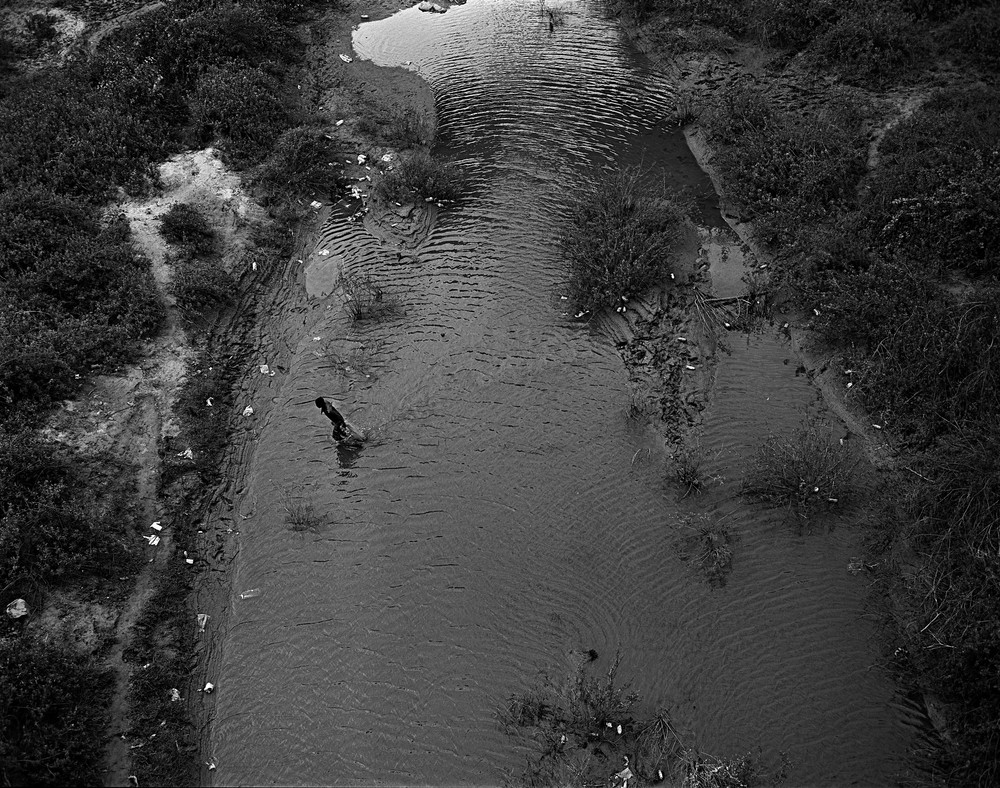
I began this body of work by documenting no man’s land on the border between Zimbabwe and South Africa. According to the Cambridge University Press (2008) ‘no man’s land’ is defined as “an area or strip of land that no one owns or controls; a land that is unoccupied due to fear or uncertainty.” With a large format camera on a tripod, attached to the railing of Beit Bridge, a series of nine black and white photographs were taken from a bird’s eye position. The photographs were taken from border fence to border fence. This was done over a period of four days (over two seasons: winter and summer) in order to match the lighting and contrast of each image. On the third day I witnessed a Zimbabwean man crossing illegally from Zimbabwe into South Africa with a single bag. My camera was set up on the left tributary of the Limpopo River; I loaded a dark slide and waited for the moment the man would enter the frame. Like the man without an identity who crosses illegally from Zimbabwe to South Africa, I too (because of my queer sexual identity) become illegal if I enter Zimbabwe. A single imagined boundary line in the Limpopo River determined both of our constitutional rights. The imagined line within this space confronted the embodiment of my sexuality and identity. Queer studies of sexuality, space and embodiment explore the “postmodern politics of place in all of its contradictions, and in the process, they expose the contours of metronormativity” (Halberstam, 2005: 15), what author Sarah Nuttall (2005: 219) refers to as the “political and gendered myth making to which the land has been subjugated.” The Limpopo was a metaphoric boundary that separated and defined my existence and the existence of the man crossing ‘no man’s land’. As I watched the man, wet with so few belongings and clearly no means for procuring legal identity, I also felt the impact of a socio economic border. I looked down on a man dispossessed as he crossed into a new land, beyond the “the bounds of a police state, into a democracy of economic promise” (Nuttall, 2005: 221). Beit Bridge, as a physical marker, was a liminal site that represented the tension of Zimbabwe on the one side and South Africa on the other. Simmel (1909/1997: 64) sees the bridge as “symbolic of the extension of our volitional sphere over space.” In my case Beit Bridge constituted a threshold of a volitional political space, and as such, became a symbol of a queer and economic border. This visual research led to my concern with the crossing of borders, not only as “national signifiers but as internal markers of potential insight and change” (Nuttall, 2005: 221). Ideological constructs ground a social and political order of the imaginary; imaginary entities are perceived and credited as indisputable social reality. The constructed border physically represents an imaginative, mental border (van Houtum, 1998; 1999). As such social reality in different spaces can be changed by imagining it in different ways that are more inclusive, more humanitarian. The humanitarian border emerges once it becomes established that border crossing has become, “for thousands of migrants seeking, for a variety of reasons, to access the territories, a matter of life and death” (Bröckling, Krasmann & Lemke. 2011: 138139). no man’s land asks for the reimagining of borders and the reimagining of outsiders as insiders; the imaginative framework that allows people to meet and interact with ‘Others’, with ‘strangers’, in effect to open the door and cross over the bridge.
No categories selected
Photos (5)


