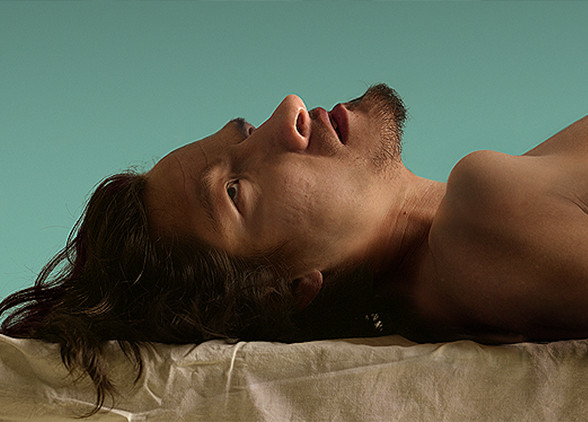

Portrait of a Certain Deceased
This series, created in 2010, is inspired by the work Christ in the Tomb by the British painter Hans Holbein. Holbein depicts a Christ who has lost his divinity—a rigid, cold corpse seemingly confined in an inescapable stone tomb, gazing into a silent world. As viewers contemplate this body, they are struck by a sense of loneliness and helplessness. In Portrait of a Certain Deceased, I employ photographic collage to place individuals from various social classes in poses reminiscent of Christ’s silent body. The series aims to capture the plight faced by those living at the margins of society: they are silently buried under the relentless wheels of time, akin to “human mines.” Rather than portraying specific suffering, the work explores an inexpressible sense of oppression—a static condition ensnared by history and society. China has undergone a rapid transformation from being the “world’s factory” to navigating an increasingly complex international landscape, and individual destinies have shifted accordingly. The weight of this series, created ten years ago, remains heavy today, precisely because these profound changes have not led to greater freedom or liberation. Instead, the evolution of social structures seems to further entrap ordinary people in invisible constraints. As the scales of power tip, individuals are often the first to be overlooked. These silent groups are swept along by the tides of time, powerless to control their own destinies, appearing as mere fragments in a larger tableau. The poses of the figures in the series symbolize this silent sacrifice. The voiceless faces and still bodies have become hidden costs within a broader mechanism. Through this series, I hope viewers can reflect on these seemingly silent existences—individuals burdened by history yet perpetually trapped in a reality with no escape. The dilemmas of a decade ago persist today in another form, and the hope for redemption may feel more elusive than ever. ——Zhang Wei
No categories selected
Photos (11)