
ZOOM PHOTO FESTIVAL
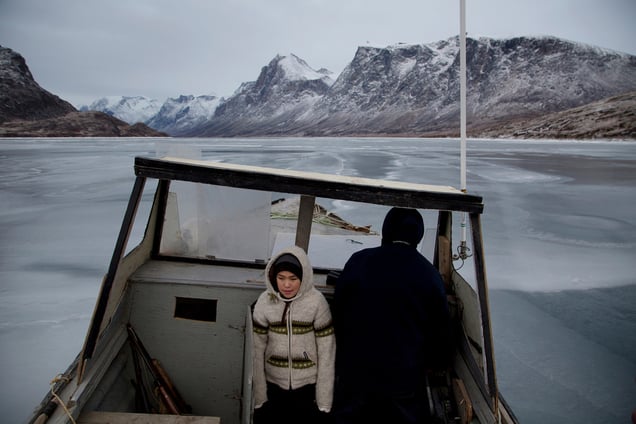
Set in Saguenay, a small city located 200 kilometers north of Quebec, Canada, Zoom photo festival has won its spurs supporting local documentary photographers rather than positioning itself as a festival of the industry. Mostly unknown at an international level, Canadian photography proves its relevance and creativity, leapfrogging to experiment new narrative possibilities. General and Artistic Director of Zoom Photo festival, Michel Tremblay, and Laurence Butet-Roch, a photographer and photo editor who joined the team last year, told Blink’s Laurence Cornet about Canada’s visual landscape. Laurence Cornet: How did the Zoom Festival start and evolve over the years? Michel Tremblay: The festival was born in 2010, inspired by many magazines that were showing the work of great photographers. Visa pour l’Image was an inspiration as I am passionate about photographers traveling the world to show it. We started with 8 to 10 exhibitions to establish the credibility of the festival. We had enthusiastic responses so, we slowly increased the number of exhibitions and started to travel to see other festivals. We went to Visa pour l’Image and World Press Photo where photographers Maxime Corneau and Nicolas Lévesque introduced us to people. Networking at these events helped us grow the festival. Laurence Butet-Roch also contributed to increase the aura of the festival. We might only have 16 exhibitions this year, but the quality is really high. Since the first year, we have had a competition about man within his environment called Human Nature, for which we receive a lot of submissions. Last year, we had a competition in partnership with Reporters Sans Frontieres. The winner, Romain Larendeau, will have an exhibition of his work at the festival this year. We just launched another competition in partnership with Italian festival Transizioni and French organization, FreeLens, that is called Nouvelles Ecritures and rewards multimedia works. Laurence Cornet: Is it a response to the specificities of local photojournalism? Laurence Butet-Roch: One of the reasons why I came back to Canada is my determination to support various journalistic projects here. The quality of production is exceptional and the language quite unique – it’s a non-traditional approach of documentary, imbued with poetry. Unfortunately, there is not yet a proper market for photography here. Though there has been a renewal for the past five to six years, with the rise of festivals such as Zoom, or organizations like ONF (National Office for Film) who are leaders in the field of interactive documentaries. They are behind The Enemy, by Karim Ben Khelifa, and Fort McMoney, by David Dufresne and Philippe Brault. Montreal also hosts a bunch of startups focusing on journalism and virtual reality. So, ideas are booming, along with a strong will to find places to show and share these projects with the rest of the country. The problem is that we are a vast country with a limited population that looks for information in foreign press. So, the local landscape is mainly made of regional papers that just start to develop an interesting photography direction. La Presse, for instance, with the app La Presse +, gives more space to images. The Global and Mail also started to print double spreads. Our visual history is young, but a lot of photographers strive to show that there are important stories here. Laurence Cornet: How does the festival position itself within this context? Michel Tremblay: The festival brings in a lot of spectators, specially students. We have had more than 6,000 students visit the festival since . Our responsibility is to help create a visual culture in Quebec. This is the reason why the festival doesn’t take place in Montreal or Toronto but in Chicoutimi, where access to quality reportages produced in Canada is not easy. We bring images to the people, and they realize that a photo can be stronger than what they see on TV. In the meantime, the festival distributes local stories and inspires photographers to work in-depth here. It looks like photographers have a hard time doing it, and it’s maybe because of a lack of means. This is the reason why we have a competition and we feature reportage on our Website once a month. Laurence Butet-Roch: The challenge is to have the rest of the world understand that they should look at what is happening in Canada because these are problems that they may face and in which Canada has some experience – good or not. For a long time, Canada has had a very good image internationally – vast landscapes, welcoming people. It’s not entirely true anymore, and photographers who work in Canada have a role to play in raising awareness about the real face of the country. Their challenge is to prove the relevance, at an international level, of what is happening here. Laurence Cornet: Can you give some examples of such stories? Laurence Butet-Roch: We can thank Stephen Harper for having destroyed the country because now we have plenty of stories. Canada is a developed country but relies economically on the exploitation of its natural resources, which presents of lot of risks. Oil sands in Alberta for instance is one of the most known of issue in Canada because their disastrous environmental and social impact. Every mining or lumbering activity in the country should be documented and monitored to make sure they are developing in respect of the environment and the future of the country. There are stories about a project of pipeline crossing the country until the U.S., and about gold mining in the Arctic. Climate change will have a huge impact on the Northern regions of Canada. Canada has a very dark past in terms of its treatment of First Nations, and there is still a lot of racism today. Just like in Europe and the U.S., Canada faces immigration and population aging. So, there are plenty of stories, and I think photographers see them. The question is: “Where do they distribute them?” If these stories only interest Canada, that has only 2-3 festivals and about 10 publications, that doesn’t leave much room for them to be told. Laurence Cornet: What opportunities do you see? Laurence Butet-Roch: There is a Canadian School of photojournalism that is currently taking shape and editors should know about it. Our partnership with Blink will contribute to that awareness because if I were an editor and saw so many photographers in Canada, I would think that something is happening here and would like to explore more. Everything is yet to be built, but there is a real visual culture developing in Canada, with the rise of new storytelling tools and mutual support among photographers. It’s an advantage for Canada not to have a photographic background. Everything is allowed and we can experiment. Michel Tremblay: That’s what is interesting about the festival: we are part of this effervescence.
No categories selected
Photos (14)