The story might begin with “Once upon a time...” and tell of a king and queen who plan to marry their daughter to the highest bidder. A great banquet is held, and people flock from all corners of the kingdom to witness the spectacle. The royal parents dress their daughter in a splendid gown and deck her out with magnificent jewels before presenting her at the festivities. Princes arrive from near and far to seek her hand in marriage. Only those who are able to offer the daughter’s weight in gold will be considered worthy candidates.
Once upon a time is still happening today. Not at all far away from Western society, on the European periphery, ancient traditions from a distant past are alive and well. Bulgaria, which joined the EU in 2007, retains rituals that must seem strange and peculiar for visitors. A striking example is the bridal markets, where young women are sold by their parents.
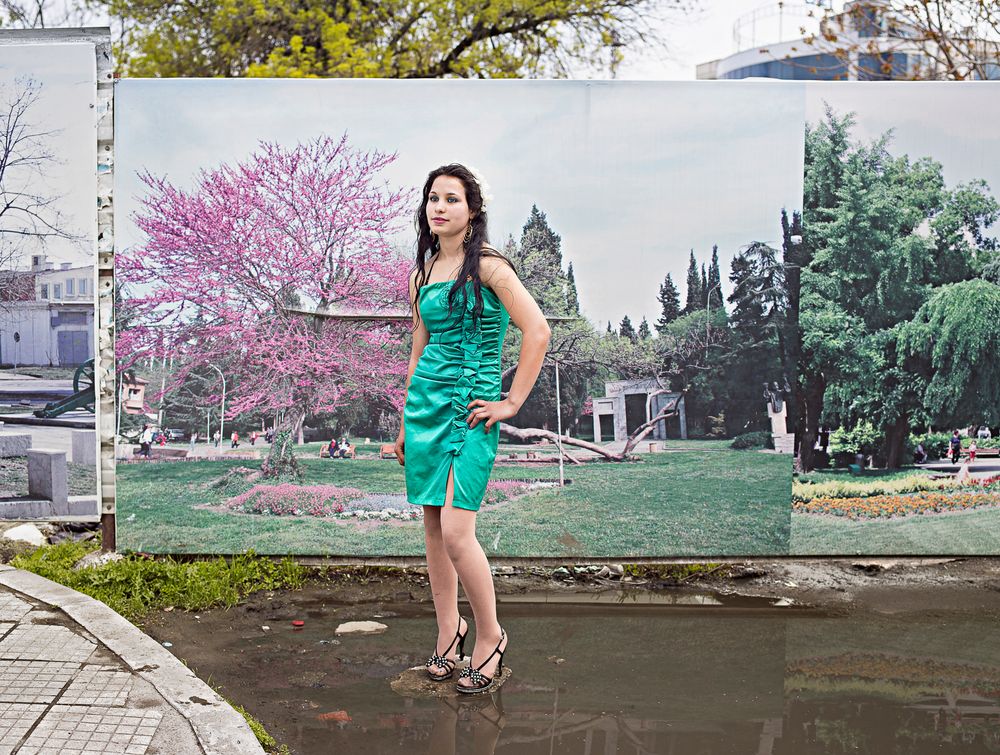
The series “The Bartered Bride” takes us on a journey deep into an archaic world inside modern-day Bulgaria. Giant picture billboards surround the trash-strewn parking lot, exuding the idyllic glow of nature scenes and the luster of the erstwhile ostentatious socialist architecture and sealing it off from the bustle of the city. This is where the orthodox Roma, a marginalized group, are tolerated. Families come together twice a year to offer their daughters of marriageable age for sale.
The young women, ranging in age from 14 to 20, are dolled up like synth-pop divas—tight clothes, high platform pumps, glamour, gold, and glitter, bright colors and whitened faces—to satisfy the primitive need to impress the men. The blonder the hair, the whiter the face, the bluer the eyes, and the purer the lass, the higher her price will be. Love is part of it, but money, a whole lot of it, is paramount. When two young people want to marry, the groom’s parents have to put up anywhere from 5,000 to 20,000 euros. This is not a dowry given to the bride and groom: it is kept by the woman’s family as a sort of bounty.
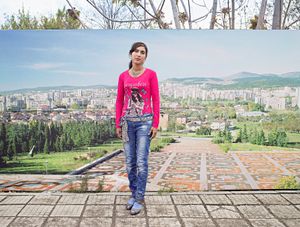
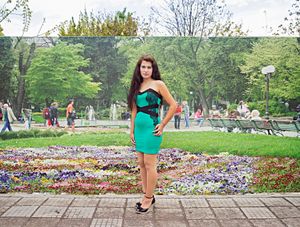
My aim was to extricate the young girls from the elaborate ritual dramaturgy of the bride market to take their photographs. I posed them in front of the bizarre trompe-l’oeil walls I had come upon outside the market, where the girls present themselves with poise and confidence. The random backdrop created by the billboards, which merge into the stark reality all around, makes everything appear magical and surreal. Only a thin wall separates truth from fiction. The girls pose like pop stars in hopes of finding their true prince on the market. This is their brief moment in the limelight and also in their hope. And yet a certain shyness and vulnerability shine through, a foreboding that their fate has already been sealed.
The brides-to-be have little chance of escaping their traditional female role. In the ex-Communist country, no sympathy is wasted on minorities. Discrimination against the Roma is widespread in Bulgaria, preventing them from getting an education and leaving them socially isolated. For the young Roma women, tradition is thus ultimately a greater good than self-fulfillment. Life in this community is nothing like a fairy tale, and yet: they still live this way happily ever after.